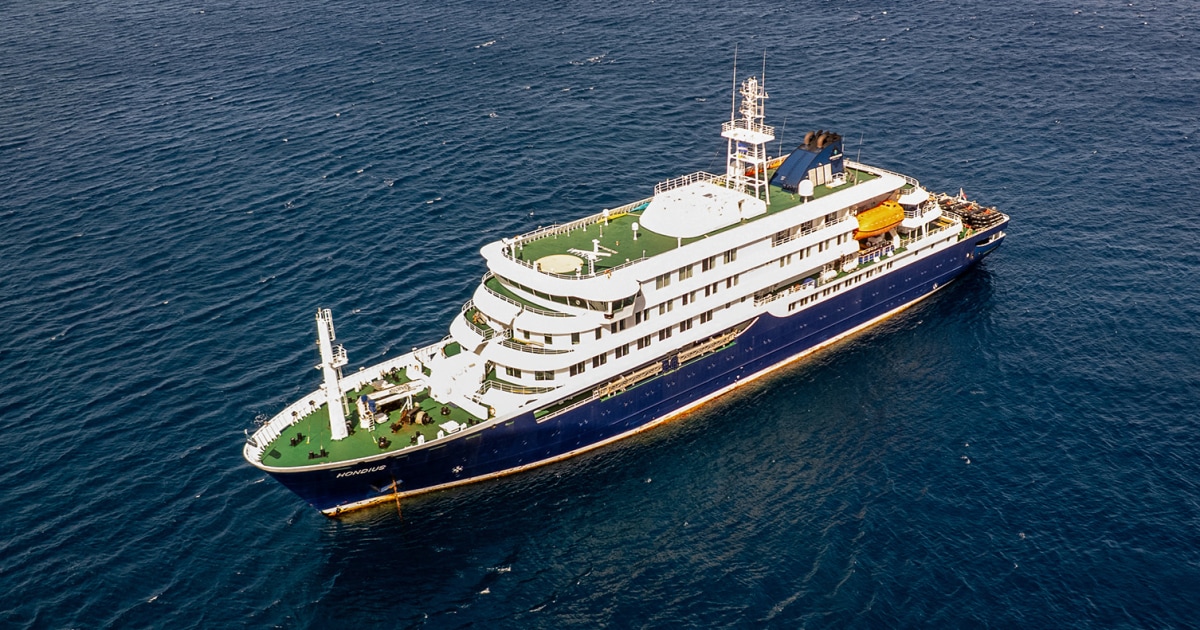
The World Health Organization said Tuesday that some passengers aboard the MV Hondius cruise ship may have been infected with the deadly hantavirus through person-to-person transmission, an extremely rare occurrence that scientists are racing to confirm.
Subscribe to read this story ad-free
Get unlimited access to ad-free articles and exclusive content.

“Our assumption is they were infected off the boat and then joined the cruise,” Maria Van Kerkhove, an American epidemiologist and technical adviser to the WHO, said at a news briefing early Tuesday. “However, we do believe that there may be some human-to-human transmission that’s happening among the really close contacts, the husband and wife, people who’ve shared cabins, etc.”
There have been two confirmed cases of the virus, and five others are suspected. Three people have died. One patient is in intensive care, and three people are reporting mild symptoms, according to the WHO.
Nearly 150 passengers remain quarantined on the ship, which is docked off Cape Verde but will eventually move to the Canary Islands.
Health officials and the cruise ship company have yet to say when the passengers will be allowed to leave. The European Center for Disease Prevention and Control said Tuesday afternoon that patients who need urgent care are being evacuated. The rest will continue to the Canary Islands, where the rest of the crew and passengers will be examined, treated and then transferred to their home countries.
Because the incubation period for the virus can range from two to eight weeks, it’s still possible more passengers will develop symptoms.
Hantavirus is typically spread by rodents through feces, urine and saliva. People become infected when they breathe particles in the air containing the virus. It can spread anytime, but previous cases have been reported in the spring and summer when there is more rodent activity and while people were sweeping during spring cleaning, not realizing that rodents had been hibernating in warm corners of their home for the winter.
There have been a handful of documented cases of transmission through contact with other infected people. That type of spread has been linked to only one strain of the virus, called the Andes strain, found in South America, which is primarily carried by a species of rodent called the pygmy rice rat.
“The majority of hantaviruses cannot be spread through human-to-human spread,” said Sabra Klein, a professor in the molecular microbiology and immunology department at the Johns Hopkins Bloomberg School of Public Health. “This happens to be the only one. It is still unbelievably rare.”
While other viruses, like Covid and flu, are transmitted easily between people — through sneezes or while eating with infected people — Klein said it’s incredibly difficult to spread the Andes strain.
“Andes virus, as a hantavirus, requires a significant degree of contact with bodily fluids,” she said. “In the original reports that came out in the early 2000s, case studies show spread between married couples, people who live together and are intimate. That is where you have the spread.”
Case reports of person-to-person spread have been documented over the years, but there has been little research into the science behind those clusters. For instance, doctors and scientists have no idea how much virus in bodily fluid is enough to infect another person.
“It’s not really understood,” said Dr. Shauna Gunaratne, an assistant professor of medicine at Columbia University Irving Medical Center.
There’s no cure or treatment for hantavirus. Doctors often prescribe supportive care for severe cases, which often includes oxygen therapy and blood pressure medications to stabilize the cardiac and respiratory systems, Gunaratne said.
The cruise ship departed from Ushuaia, Argentina, on April 1 with 88 passengers and 59 crew members. It stopped at multiple islands across the South Atlantic Ocean and in mainland Antarctica.
Five days after the ship sailed, a 70-year-old male passenger reported fever, headache and mild diarrhea. After he developed respiratory distress, he died April 11, although the cause of death wasn’t yet determined.
Nearly two weeks later, his body was removed from the ship when it docked in St. Helena, a British overseas island territory. The man’s wife, 69, was experiencing gastrointestinal symptoms on April 24 when she went ashore at St. Helena. She deteriorated during a flight to Johannesburg and died when she arrived in South Africa on April 26. The third death was that of a woman whose symptoms started April 28. She died five days later, on Saturday.
Dr. Lucille Blumberg, an infectious disease specialist at the National Institute for Communicable Diseases in South Africa, was one of the first scientists notified of the mysterious outbreak on the cruise ship and helped point colleagues to test for hantavirus. According to Blumberg, the outbreak could have started after a birding expedition.
Because the virus is so difficult to spread between people and can take weeks to develop symptoms, Klein isn’t sure how much person-to-person transmission occurred in the outbreak. She did note that two of the people who died were married.
“It is so much more likely that either while docked in Argentina, if there was any kind of tourist location that many people went to in Argentina where there could have been exposure to the rodents or if these pygmy rice rats somehow made it onto the ship with supplies, including food, including fresh produce … that would be how you could also have transmission,” she said.
A race to identify the strain of hantavirus
Morgan Gorris, a scientist at Los Alamos National Laboratory who has studied the hantavirus, said the first step in figuring out the mode of transmission is to identify the strain.
“There are many different hantaviruses that cause disease, and a lot of them are regionally located,” she said. “So if we can identify which hantavirus caused this disease, that will give us a clue to where the cases originated.”
Blumberg said it’ll most likely take a few more days to determine the strain.
“You’re doing a sort of deep dive and fingerprint of the virus, and that’s in process right now,” she said. “Those are much more complicated tests. You have to really take a big part of the virus and sequence it.”
There are nearly 40 strains of hantavirus found all over the world, and different strains cause different illnesses, according to the U.S. CDC. All of them can be severe, though the Andes strain is particularly deadly, killing nearly 40% of those infected. The strain found in the southwestern U.S. called the Sin Nombre strain — the most common type of hantavirus, which was discovered in the U.S. in 1993 — has a 25% fatality rate.
As scientists race to identify the strain, almost all of the passengers are still quarantined on the ship.
“Until we know where this occurred and how, I think that is why they’re engaging in this quarantining practice,” Klein said. “I know that’s got to be scary; to be scared that you might have been exposed to a virus that’s a hemorrhagic fever virus, that is, that is, that’s very unnerving.”
While a quarantine on a cruise ship may bring back memories of the early days of the coronavirus pandemic, the scientists stressed that this is a very different situation.
“It’s not like Covid,” Blumberg said.