Silvana Toska was playing in a grass field with her daughters late last fall when she felt a sting on her ankle. The family had come to listen for barred and great horned owls as the sun set on a large park near their Davidson, North Carolina, home.
It was “just like a mosquito bite, nothing major, and I just scratched it,” said Toska, a political science professor.
Then she began to itch everywhere. She couldn’t see anything in the dark, so her husband shined his phone light on her.
She was covered in hives.
Because she also felt pressure in her chest, the family quickly went to an urgent care clinic. A doctor there recognized she was experiencing anaphylactic shock, a life-threatening, fast-moving allergic reaction.
The doctor rushed her to a room without checking her in, saw her blood pressure was low, and administered two epinephrine injections and IV fluids, Toska said. The itching stopped, and the tightness in her chest went away.
But the doctor said she needed to be monitored in an emergency room for at least two hours in case the reaction flared up again. Toska said the doctor insisted she take an ambulance to a nearby hospital, Atrium Health Lake Norman.
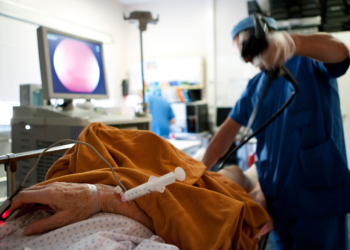
Minutes later, she found herself lying on a stretcher in the ER.
A doctor she described as “lovely” came in and spoke to her for no more than five minutes, Toska said. A nurse administered medicine through the IV line inserted at the urgent care clinic.
Toska was exhausted, but her mind was on her daughters. “I had two little kids who were scared, so I was playing with them and trying to distract them.”
After about an hour and a half, the doctor returned briefly, then the family went home, she said.
“That’s it,” Toska said. “Nothing happened at the ER.”
Then the bill came.
The Medical Service
Toska said the ER doctor reviewed her vitals and discussed her allergic reaction and what to watch for when she got home. She also received a dose of famotidine, a drug often used to treat an upset stomach that is also administered for allergic reactions.
The Bill
The in-network hospital system charged Toska’s insurer, Blue Cross Blue Shield of North Carolina, $6,746.50 for the ER visit, including $20.60 for the famotidine and $6,445.60 in “critical care” charges. Toska, who had not met her insurance deductible, was responsible for a $150 copay and $3,100.24 of the charges.
The Billing Problem: Critical Care
“Paying $3,100.24 for literally sitting in the ER entertaining my kids for an hour and a half feels kind of incredible,” Toska said.
Medical providers in the United States use a uniform coding system to bill for procedures and services. Most of Toska’s ER charges stemmed from Atrium Health’s use of two billing codes for “critical care” — one for 30 to 74 minutes of care, at $5,617.85 (code 99291), and another for an additional 30 minutes (code 99292), at $827.75.
According to the coding system, critical care is generally defined as when a doctor “directly” provides at least 30 minutes of care to a patient with “a probability of imminent or life-threatening deterioration.”
According to the ER’s visit notes, which Toska shared with KFF Health News, Toska told the doctor there she was feeling “significantly better” when she arrived, and the doctor reported providing 90 minutes of personal critical care.

Anaphylactic shock is treated under code 99291, according to the American College of Emergency Physicians coding guidelines. Though Toska’s symptoms may have indicated she was no longer in shock, treatment guidelines require at least two hours of monitoring, said Arjun Venkatesh, the chair of emergency medicine at the Yale School of Medicine.
With anaphylaxis, “some people are going to progress and require admission to the ICU, and some won’t,” Venkatesh said.
Toska was under critical care because of what could have happened, not what did happen, Venkatesh said. Hospitals use the same billing codes for the ER visit, whether a patient’s condition deteriorates or not.
“The billing rules are not built around this,” Venkatesh said.
Laura Eberhard, a spokesperson for Blue Cross Blue Shield of North Carolina, said Toska’s claims “were submitted by the provider using critical care codes, which represent a higher level of severity and reimbursement, and were processed in-network under the terms of the member’s plan.” She did not answer questions about whether Blue Cross Blue Shield negotiated the charges.
A spokesperson for Atrium Health did not answer questions from KFF Health News about Toska’s visit.

The Resolution
Toska said she called Blue Cross Blue Shield of North Carolina, trying to get a better explanation for why the bill for so little hands-on care was so high.
“The doctor determines the severity of the situation, and that’s the code we have,” the insurance representative said, according to Toska’s recollection. “This is critical care, and that’s what it costs.”
After Toska contacted the hospital, Atrium Health’s Audit and Appeals Department replied in a letter that the critical care designation was “based on the presenting problem that brought you to the emergency room, the treatment provided, and the nursing staff that took care of you.”
“It also includes the room, supplies, and equipment utilized during the visit,” the letter continued. “The charge is not based on time spent in the facility or with clinicians.”
Asking why the ER visit cost so much was more a matter of principle than necessity, she said, though she thought back a few years to a time when it would have been much harder for her to pay.
“The system is so broken,” Toska said.
The Takeaway
“Her experience is, sadly, very typical,” said Barak Richman, a professor of business law and co-director of the Health Law and Policy program at George Washington University. “Once you are brought onto the train of health care delivery, you have no control over where the stops are.”
Emergency rooms — for many the default choice for medical care — are notorious for high costs, he said, adding that insurance companies should always try to negotiate critical care codes.
Toska was fortunate to dodge another problem common in emergencies: The bill for taking an ambulance to the ER was about $275, she said, notable since ambulance rides frequently result in bigger bills that may not be covered by insurance.
Patients can dispute charges with their insurance and the hospital. Like Toska, they should come to the phone with an itemized bill, medical records, and any other relevant documents, such as explanation-of-benefits statements.
Regardless of whether that’s a fight they can win, some who see one ER bill decide they never want to see another, especially if it might put them in medical debt.
In early March, Toska had a second allergic reaction. “OK,” she recalled thinking, “Do I go get the EpiPen? Do I go to the ER and get another massive bill?”
She decided against the trip and took Benadryl instead.
Bill of the Month is a crowdsourced investigation by KFF Health News and The Washington Post’s Well+Being that dissects and explains medical bills. Since 2018, this series has helped many patients and readers get their medical bills reduced, and it has been cited in statehouses, at the U.S. Capitol, and at the White House. Do you have a confusing or outrageous medical bill you want to share? Tell us about it!