What Is Fever?
Fever is a regulated rise in core body temperature, usually ≥38°C (100.4°F), caused by activation of the hypothalamic thermoregulatory center. It is a symptom, not a disease, and often reflects an underlying pathological process—most commonly infection, but not always.
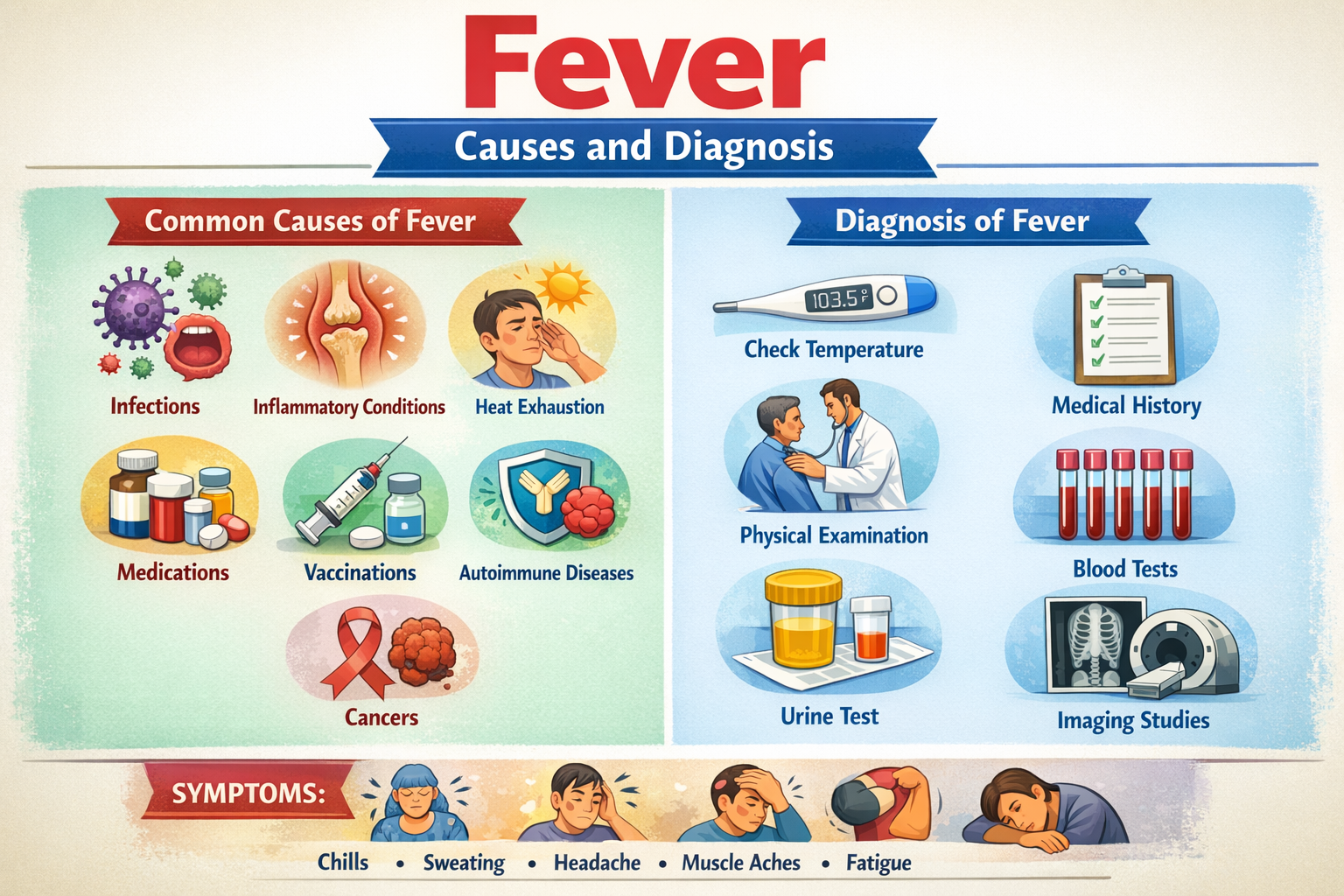
Common Causes of Fever
Fever can be broadly classified based on etiology:
1. Infectious Causes (Most Common)
- Viral: Influenza, COVID-19, dengue, chikungunya
- Bacterial: Typhoid, pneumonia, tuberculosis, UTI
- Parasitic: Malaria
- Fungal: Opportunistic infections (immunocompromised)
2. Non-Infectious Causes
- Inflammatory & autoimmune disorders: Rheumatoid arthritis, SLE
- Malignancy: Lymphoma, leukemia (fever of malignancy)
- Drug-induced fever: Antibiotics, antiepileptics
- Post-vaccination fever
- Heat-related illness (important differential—not true fever)
- Endocrine & metabolic: Thyroid storm, adrenal crisis
Clinical Approach to Diagnosis of Fever
Step 1: Confirm Fever
- Accurate temperature measurement (oral, axillary, tympanic, rectal)
- Pattern: intermittent, remittent, continuous, relapsing
Step 2: Detailed History
- Duration (acute <7 days, subacute 7–21 days, chronic >21 days)
- Travel history, exposure, occupation
- Drug intake, vaccination history
- Associated symptoms (rash, cough, dysuria, weight loss)
Step 3: Physical Examination
- Vitals, hydration status
- Skin (rash, eschar, petechiae)
- Lymph nodes, liver, spleen
- Respiratory, cardiovascular, CNS examination
Step 4: Investigations (Based on Clinical Suspicion)
Basic Tests
- CBC with differential
- ESR / CRP
- Urine routine & microscopy
- Peripheral smear (malaria)
- Blood culture (before antibiotics)
Targeted Tests
- Dengue NS1 / IgM, Typhoid tests
- Chest X-ray
- Ultrasound abdomen
- CT / MRI (when indicated)
- Autoimmune profile / tumor markers (selected cases)
Expert Opinion (Clinical Perspective)
In clinical practice, fever should never be treated in isolation. Empirical antipyretics may mask symptoms, delay diagnosis, and obscure disease patterns.
Unnecessary antibiotics are one of the commonest errors in fever management, contributing to antimicrobial resistance. A syndromic and stepwise diagnostic approach remains the gold standard.
— Clinical Medicine Consensus
Highlighted Key Points
- Fever is a protective physiological response
- Infection is common, but not the only cause
- Duration and pattern guide diagnosis
- Investigations should be rational, not routine
- Treat the cause, not just the temperature
🚨 Red Flags in a Patient with Fever (Require Urgent Evaluation)
- Fever > 7 days without diagnosis
- Altered sensorium, seizures
- Hypotension or shock
- Breathlessness or chest pain
- Neck stiffness, photophobia
- Petechial rash or bleeding
- Severe abdominal pain
- Fever in:
- Infants <3 months
- Pregnant women
- Elderly
- Immunocompromised patients
Management Principles (Brief)
- Antipyretics: Paracetamol preferred
- Avoid NSAIDs in dengue suspicion
- Adequate hydration
- No antibiotics unless bacterial infection is likely or proven
- Early referral if red flags present
References (PubMed / MEDLINE Indexed)
- Mackowiak PA. Concepts of fever. Arch Intern Med. 1998.
- Dinarello CA. Pathophysiology of fever. N Engl J Med. 1996.
- Cunha BA. Fever of unknown origin. Infect Dis Clin North Am. 2007.
- Petersdorf RG, Beeson PB. Fever of unexplained origin. Medicine (Baltimore).
- CDC & WHO Clinical Guidelines on Fever Evaluation.
(All references indexed in PubMed / MEDLINE)
⚠️ Medical Disclaimer
This article is intended for educational and informational purposes only.
It does not substitute professional medical advice, diagnosis, or treatment.
Clinical decisions must be individualized based on patient condition, investigations, and physician judgment.
In case of medical emergency, seek immediate professional care.
Fever-causes-and-diagnosis-